1 paper has been accepted to EMNLP 2026!
October 24, 2026




AIDAS LAB
We study fundamental model architectures, data-intensive systems, and embodied agents through an integrated approach that connects AI design, system optimization, and practical impact.
Welcome
The AIDAS Lab conducts cutting-edge research in Artificial Intelligence with a focus on fundamental model architectures, data-intensive systems, and embodied agents. What distinguishes our lab is our integrated approach: we connect innovation in AI model design with system-level optimization and impactful real-world applications. Our research is deeply grounded in practical deployment, with a particular emphasis on transformative applications in the medical and industrial domains. Led by Professor Jaeyoung Do, the AIDAS Lab is committed to pushing the boundaries of what is possible in AI through interdisciplinary and forward-thinking research.
Flagship Projects
dynin-omni
A unified generative foundation model capable of understanding and generating across all modalities — text, image, video, audio, and more — within a single coherent architecture.
dynin-robotics
An omnimodal diffusion vision-language-action model unifying sensor integrated action generation, world modeling, goal-state prediction, and task understanding in one shared backbone.
Research Areas
We advance AI through three fundamental research pillars — Core AI, System AI, and Embodied AI — and apply them to high-impact areas, including Medical and Industrial domains.

Apply AI technologies to industrial and manufacturing domains, leveraging domain expertise to address challenges such as predictive maintenance, process optimization, and intelligent automation through robust algorithms and data-driven system integration.
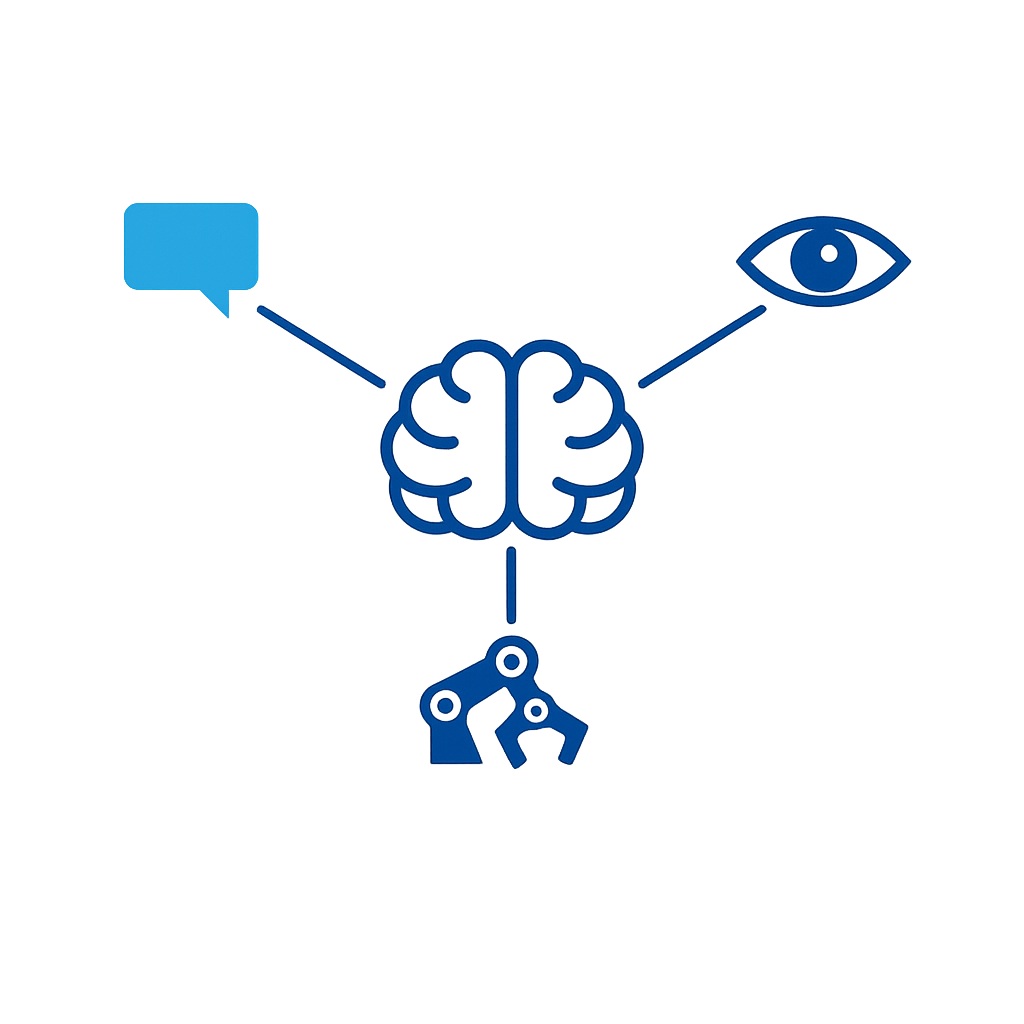
Advance generative AI by developing state-of-the-art models such as large language models, vision-language models, and vision-language-action models. Drive innovation through novel model architectures and training methodologies, enabling the next generation of multi-modal AI systems.

Enhance the scalability and efficiency of AI systems through integrated software-hardware co-design. Facilitate large-scale data processing and AI workloads through high-performance inference, training, and deployment across heterogeneous computing environments.

Develop intelligent agents capable of perceiving, reasoning, and acting autonomously in dynamic physical environments. Integrate multimodal perception, behavioral planning, and real-time control to empower autonomous systems with adaptive, goal-directed interaction.

Utilize AI to interpret complex medical data, including imaging, biosignals, and electronic health records. Improve clinical decision-making through accurate, interpretable, and deployable models for diagnosis, treatment planning, and outcome prediction.
Apply AI technologies to industrial and manufacturing domains, leveraging domain expertise to address challenges such as predictive maintenance, process optimization, and intelligent automation through robust algorithms and data-driven system integration.
Advance generative AI by developing state-of-the-art models such as large language models, vision-language models, and vision-language-action models. Drive innovation through novel model architectures and training methodologies, enabling the next generation of multi-modal AI systems.
October 24, 2026
July 2, 2026
June 18, 2026